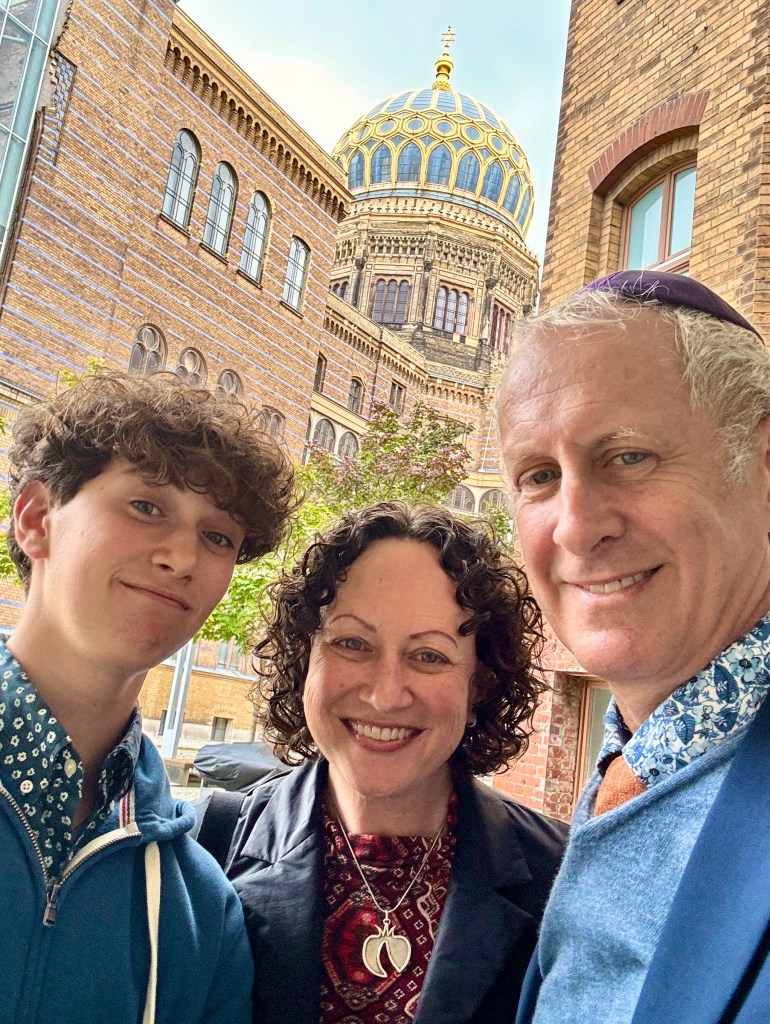
This past week has been a deep dive into our family’s German history, with my Dad’s visit prompting new opportunities to retrace our family’s past. I learned that my Dad’s side of the family lived in Germany from the mid-1600s up until 1937, and we were able to visit several places of note in my family’s past: the birthplace of my Oma (who lived to be 101) and my grandmother Lisbeth (who sadly passed away before I was born), my Poppy’s favorite holiday getaway spot along the Rhine River, and the chemical plant where my Poppy worked before fleeing the country during WWII. It was quite a trip.
Highlights included: 1) an incredible day at the stunning Jewish Museum of Berlin; 2) a visit to the beautiful Sanssouci Palace of Prussian King, Frederick the Great;

3) a raucous night of Bavarian traditions at a local Oktoberfest bash; 4) spending Rosh Hashanah celebrating Jewish tradition at a newly reestablished local synagogue dating back to 1866; 5) a day exploring the nearby town of Dessau from which my grandparents fled in 1937; and 6) a trip westward to my grandmother’s birthplace and a few of my grandfather’s favorite places. Our stops were Heidelberg, the Middle Rhine River Valley towns of Assmannhausen (the German pronunciation is much less obscene than one would think) and Rüdeheim, and lastly to the medieval city of Aachen, right next to the German borders with Belgium and Holland, which was known for its healing hot springs, and was also the former home of Charlemagne.
Driving a manual transmission rental car around to smaller towns was also part of the adventure, since I hadn’t driven one in about 20 years. Getting the car out of the six-story parking garage at the Frankfurt train station involved a lot of involuntary stalling, but I eventually figured it out, once I could find 1st gear! The automatic “lane assist” steering in construction zones with multiple overlapping yellow and white lines on the freeways was also an experience that I wouldn’t repeat. But it got the job done and was pretty fun once I got a feel for the German transmission.
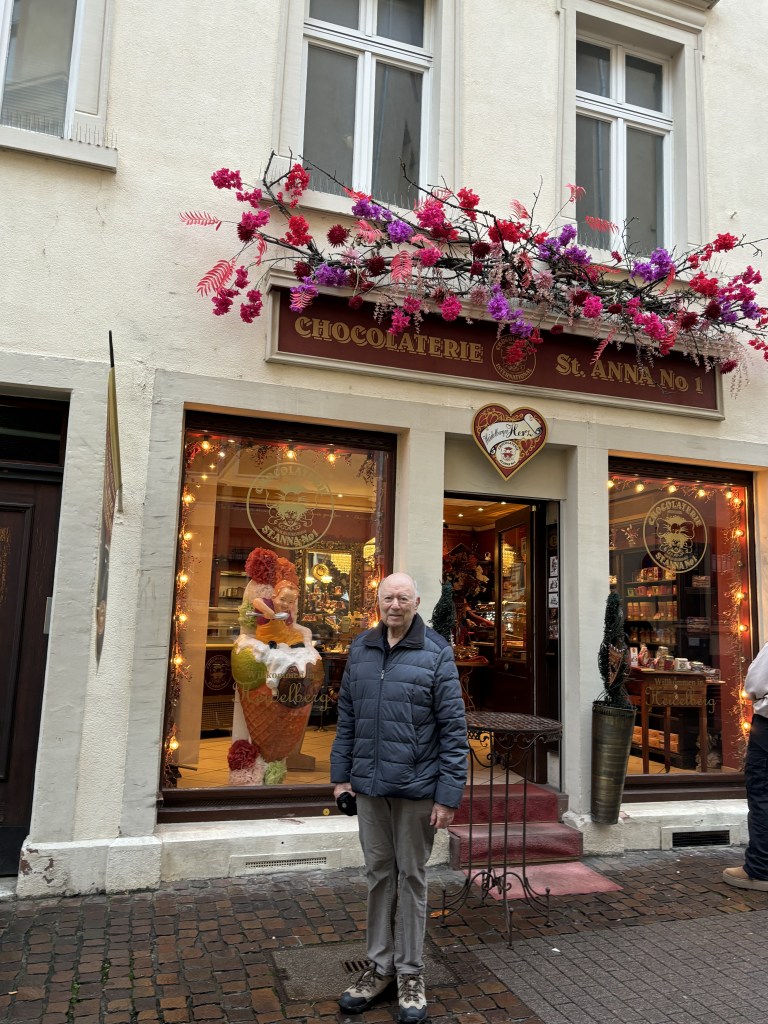
Heidelberg was just as charming and lovely as we expected, with spectacular architecture, an incredible medieval castle, and a wonderful local chocolate shop where we sampled yummy fresh hot chocolate as we popped in for a break in the rain. We ate dinner at a quaint Schnitzel restaurant that got rave reviews, even if it filled my fried foods quotient for the month.

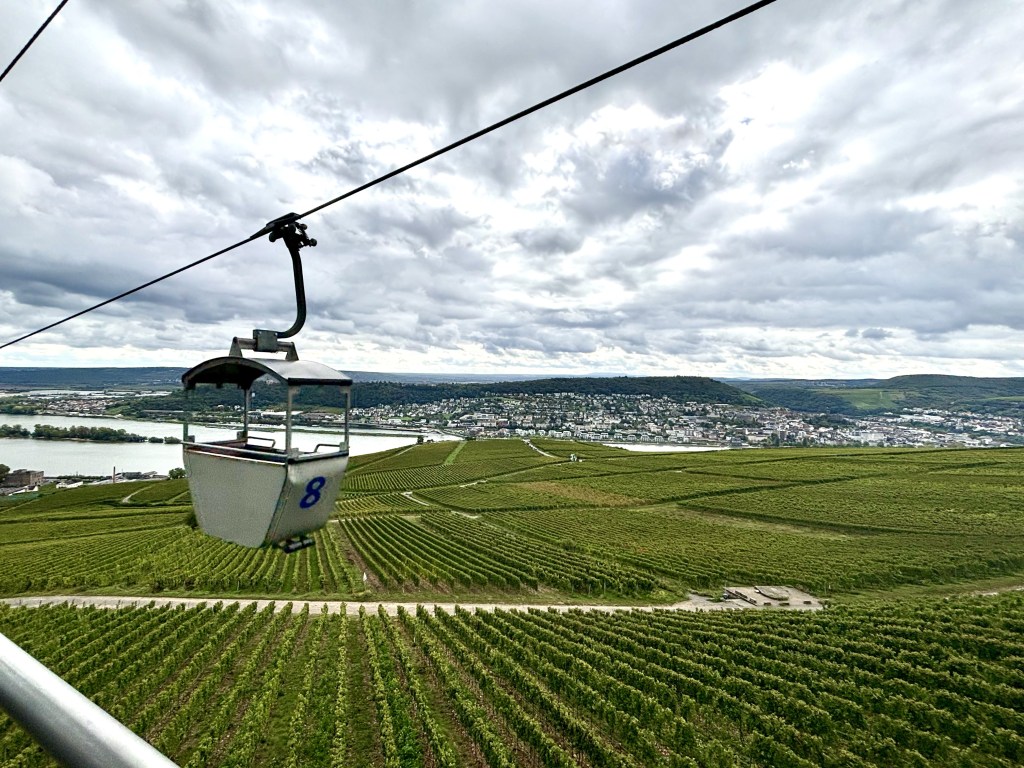
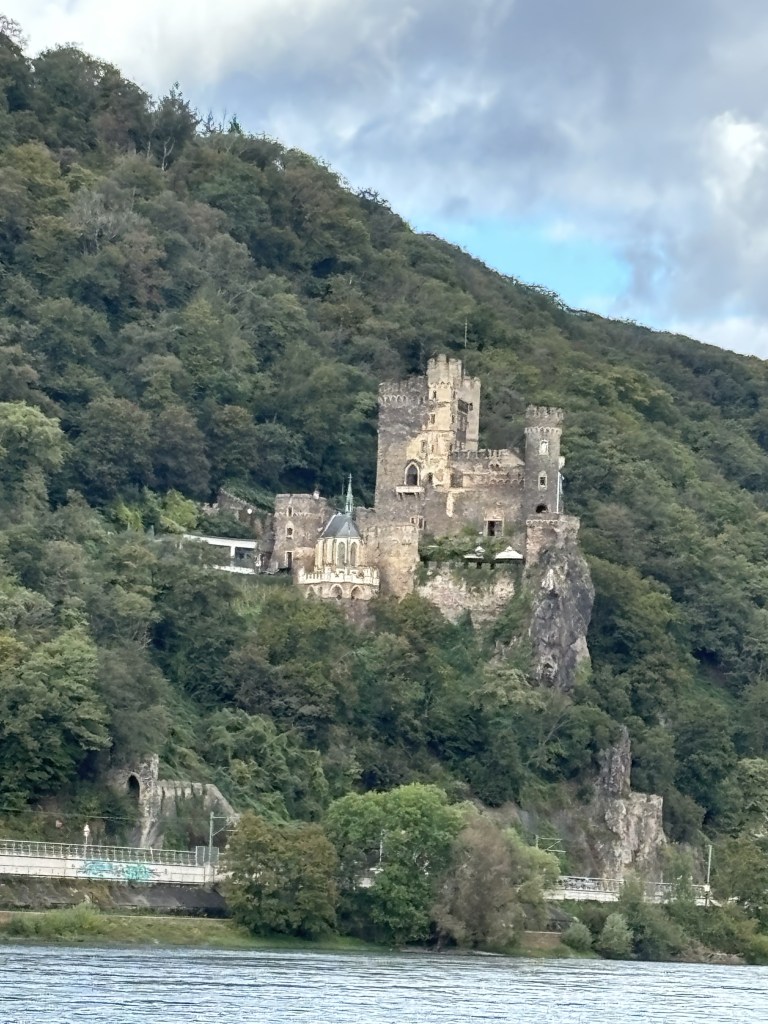
Our Rhine River day trip the next day was totally delightful and mostly sunny! The boat ride involved only about 15 minutes of time on the water, but lots of fun exploring the picturesque towns nearby via a ski lift contraption up the mountain, beautiful walking trails around loads of local medieval relics with gorgeous views of the river and surrounding villages, UNESCO World Heritage sites peppered throughout, and a gondola back down over rows of Rhine River vineyards. We ended up in beautiful Rothenburg ob der Tauber. My grandfather (Poppy) used to love taking Rhine River trips here, so I was happy we were able to follow in his footsteps. My dad sampled a bit of the sweet local wine, which was offered in little cups along the pedestrian streets.

From the picturesque Middle Rhine River Valley, we drove to beautiful central Aachen. Our journey included finding a locally owned restaurant for dinner with my dad’s favorite childhood dish that his mother used to make, a beef roulade, which he enjoyed immensely. My grandmother Lisbeth (in whose memory I was given the middle name Beth) grew up in Aachen and earned a PhD in French Literature, which was quite extraordinary for the 1930s. If only she had been able to enjoy fully using her intellect and talents! But alas, she was ahead of her time, and only lived to be 50 years old. She and my grandfather were married in Aachen as well. Lisbeth’s father Ernst owned a big department store in Aachen, and my great-grandmother Martha (who lived to be 101- hopefully I have her genes!) of course also lived in Aachen. We lucked out with a warm and bubbly tour guide named Anja who was full of anecdotes and historical knowledge, and was excited to help us look up more information about the Hirtz family history in town. She walked us around the major sites, including the resting place of Charlemagne from the late 700s, but also explained the genesis of each section of the stunning historic gothic cathedral (dom) in the center of town, complete with enormous add-ons in the 1400s, 1500s, 1800s and early 1900s that collectively represent nearly every European architectural style. The cathedral was a huge draw for hundreds of pilgrims annually and was the location for the coronation of 30 German kings. Even the enormous gothic town hall (still in use) dated back to 1350. Our guide also took us into one of several “Printen” shops downtown, which I would have assumed was a bookstore. But instead, these were cookie shops where delicious Aachen-specific treats are baked and sold. The ones we sampled were delicious, gingery and not too sweet, and decorated with cute autumnal designs.


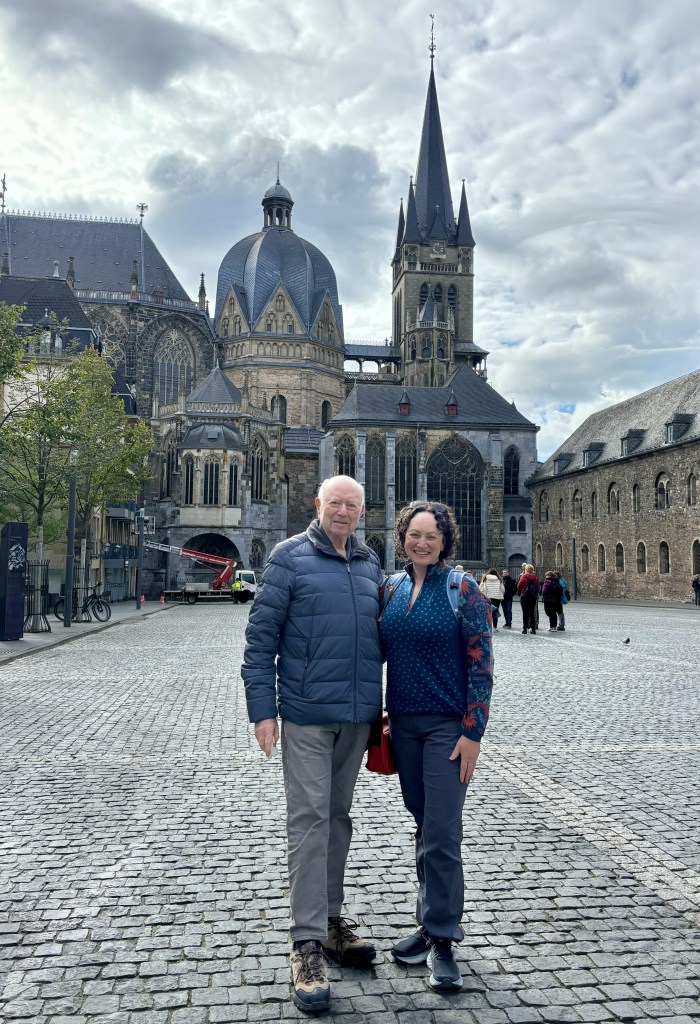
Apparently, what brought the town of Aachen back into modern interest after large sections were bombed during WWII was not the cookies, but the natural hot springs, which Charlemagne frequented to cure all matter of ailments. The hot spring waters did not do what his wife had hoped (allow her to bear a son to be an heir) but were said to cure most other medical conditions that were commonplace in the Middle Ages (plagues/pandemics excluded). I had read about these natural hot springs and decided to pay them a visit too! I had booked 30 minutes in the hammam, which I fully expected to be like those ubiquitous in Morocco with a modest tiled room, plastic tubs of warm water and an older female attendant to scrub off my dead skin. However, this place was completely different. After returning the rental car and walking about half an hour uphill to the hot springs, I was a little frazzled at reception to discover that this place was BYOT (towel) and I had none. Fortunately, they had rentals, which took awhile to find. Towel in hand, I went to change out of my clothes and encountered several more hiccups: 1) weird self-locking doors to tiny individual fitting rooms that I couldn’t open until nearly resorting to crawling out, when I fortunately spotted a small plastic latch to swing the door open; 2) lockers that were supposed to lock with the wristband provided but I couldn’t figure out how to lock; 3) no shower shoes provided and very slick wet floors; 4) roughly seven sets of staircases to various parts of the building, none of which were marked, and half of which I had to walk up to locate the hammam area. By the time I found the right area for my appointment (for which I was late at this point), my face was flush, and I had tears in my eyes from being so lost in this gargantuan building. I walked through a beautiful room with Moroccan decorated lattices where both men and women were bathing side by side in a giant warm pool (in the buff), and finally found the attendant who was kindly expecting me for the hammam. He (again I had expected a female-only space) led me into a private room that looked like a massage room, which was very confusing. Thankfully he spoke English (no one else in the place did as this was clearly not a place designed for tourists.) He asked if I had ever been to a hammam, and I replied that I’d only been to them in Morocco where they were not this fancy. In the room, there was a warm oval-shaped stone table with several small Turkish-style towels. After I got myself situated and covered up with the towels, he proceeded with the hard scrubbing of dead skin off my arms, legs and back, each followed by the loud dumping of buckets of warm water to rinse off one limb at a time. As my skin was scrubbed clean, tears welled up in my eyes as I imagined my grandmother in this town, wondering if she ever had the chance to bathe in the warmth of the mineral waters, or enjoy their healing properties. Somehow, I doubt the spa was as readily accessible in the 1920s, but who knows? My skin now feels awesome, but I was bummed that I had to just take a quick dip in one of the many hot spring pools before drying off and rushing back to the fitting room and my unlocked locker to hop in a cab for our train back to Berlin. Clearly most of the guests at the spa were spending several hours there. I’m sure it’s a welcome respite in the wintertime. But as an American, there were several missing pieces of this spa experience. Knowing about the BWOT and slippers would have been nice, as would have been a staff person to kindly walk me back to the dressing room to show me the mysterious locker system, self-locking fitting room doors and directions for the many unmarked staircases. Also missing was a vessel to get even a sip of water (clearly fresh cucumber mint spa water is not a thing in Germany) in this enormous behemoth of a spa complex. Fortunately, I had filled up my water bottle back at the hotel, which I gulped down in about a minute before hopping on the train. Overall, I would say that the spa was not exactly a relaxing experience, even if it did serve the purpose of massive exfoliation and connecting with the city’s past.
Our train journey back to Berlin took 8 hours instead of the scheduled 4.5 hours as both of our pre-booked trains (a regional one and a high-speed ICE) were cancelled for no apparent reason, and all the other trains were super packed. We got a seat on the first one but had to stand for nearly two hours on the second one and got home just before midnight instead of the reasonably scheduled 9pm arrival we had expected. I don’t think I’ll be taking long-distance trains for a while…
The week prior, we went to a lovely free lunchtime concert at the Berlin Philharmonic where people were sitting all over the floor and staircases to hear about an hour of live classical pieces. We also spent a day visiting the spectacular Prussian palace grounds in Potsdam, after which we went to a nearby biergarten for a huge Oktoberfest party with a table reserved by a group of dads at Julian’s school. Prior to arrival, I had thought that our table would be filled with couples from the school, but only one other mom showed up. Once she arrived, I hugged her before even introducing myself! We hit it off right away—she is originally from Marin (more recently from Minneapolis) and also has a son in 9th grade, so we gabbed all night. The evening’s party included a raucous live band, dancing, enormous steins of Oktoberfest brew from Munich and Bavarian food on large platters. But best of all, the celebration was a chance to wear the traditional outfits Jonathan had picked up for us in Munich about a decade ago. Getting into my dirndl was a bit of an ordeal and required procuring a new ribbon from a Potsdam fabric shop since my original had gone missing, but it all came together. Jonathan also had a fashion emergency with a last-minute buckle break on his suspenders that we temporarily fixed with safety pins and a carabiner at a bus stop en route.
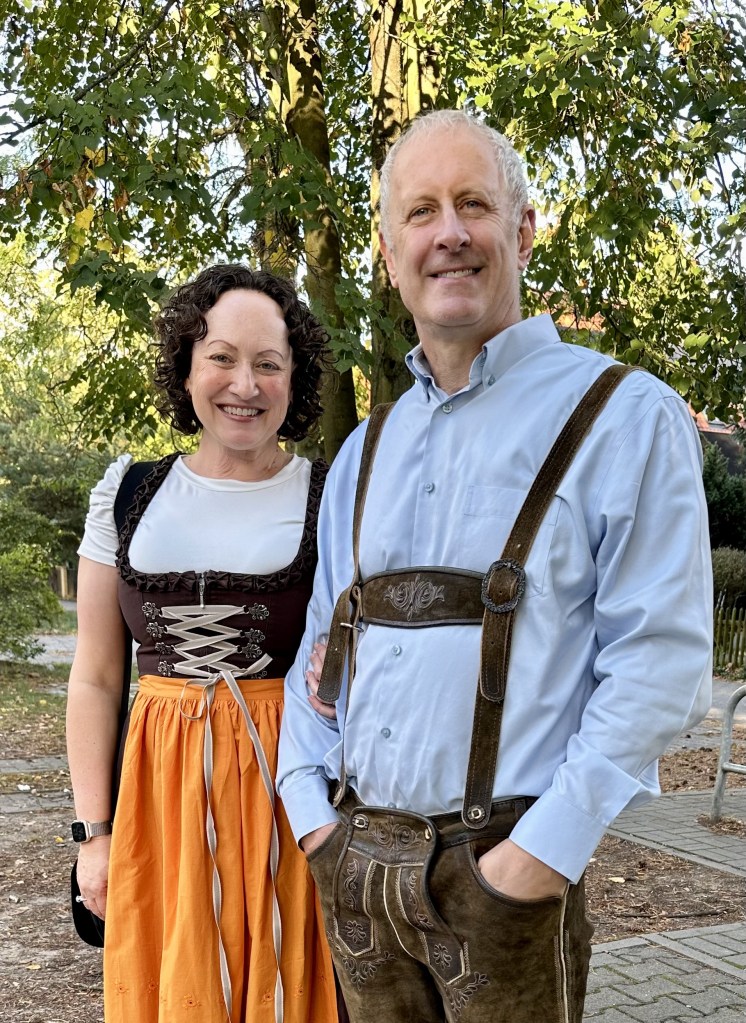
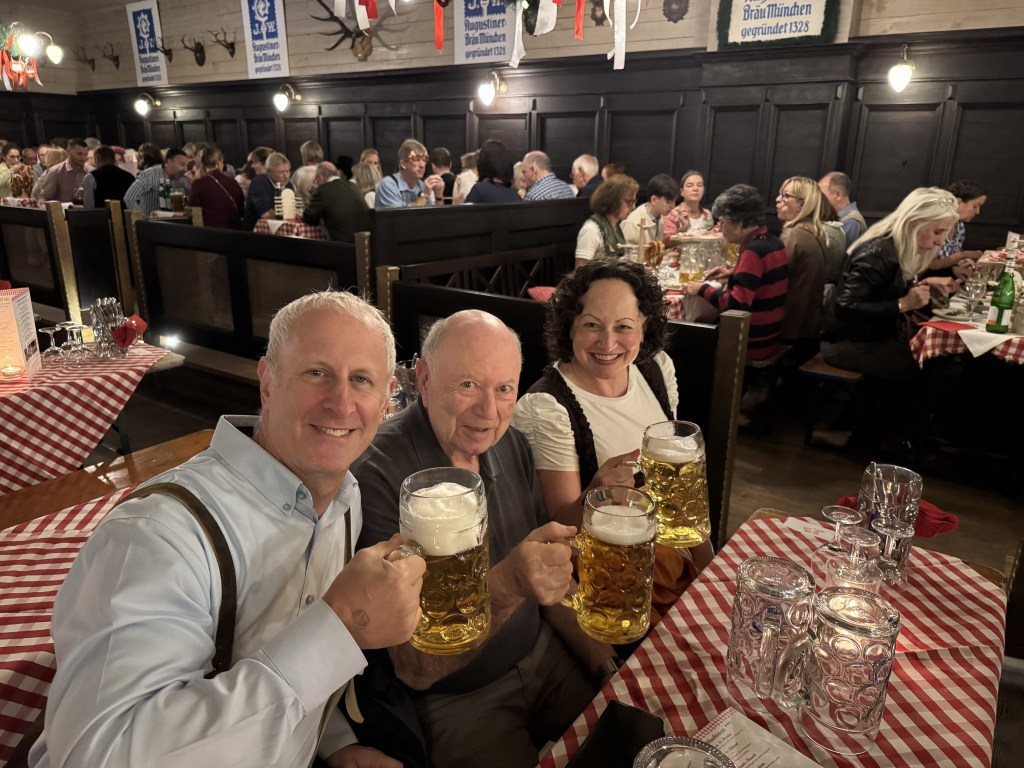
Among the other dads at the table were a couple of others who were descendants of Holocaust survivors. The most surprising of them was a jovial guy from Bolivia who went to the University of Oklahoma but is also here with his family on new German passports. His Jewish grandfather fled to Latin America as a Holocaust survivor after the camps were liberated. I never would have guessed– and I had chatted with this dad at several of the earlier parent socials. He was so touched to see my dad so thoroughly enjoying the Oktoberfest festivities and moved by the power of our reconnecting with our German past. We toasted our steins to this shared reconnection with a country where our grandparents were horribly mistreated, and from which they narrowly escaped.
However, visiting the town an hour south of here that my grandparents fled was not what I had expected. The chemical company where my Poppy had worked (IG Farben) was in Dessau, and I’ve always thought of it as the company where Poppy’s boss saved our entire family. As the story goes, his boss learned that the SS would be coming around (in late 1937) and asking him to turn over a list of his Jewish employees. So Poppy was given a clandestine order to head with Lisbeth and toddler Albert to Holland on a local train to avoid suspicion, for which his boss handed him tickets (he wouldn’t have been able to buy them himself at that point.) The boss also took care of sending all our family furniture and belongings straight to San Francisco, and most importantly, booking three spots for my grandparents and uncle Albert on a ship to Ellis Island in early 1938. What a miracle. Unfortunately, soon thereafter, the Nazis took over the company and moved it right next to Auschwitz to produce the chemicals used in the gas chambers. No joke. Horrifying. The company was disbanded after WWII. That explains the abandoned buildings we saw right after exiting the freeway. They were super creepy. Lots of bricks, broken windows, graffiti and overgrown weeds with mangled barbed wire fencing up in some places and dismantled in others. We passed by a local couple who flagged down our car wondering what on earth we were doing there, and using Google Translate on our phones, were able to confirm that the crumbling brick complex was the former location of IG Farben.


We also saw a brand-new Bauhaus inspired synagogue in Dessau that just opened in 2023, on the same grounds as an old synagogue stood from 1909-1938 that was destroyed just after my grandparents left. The police presence around it was indicative of the current political climate. Other than that, the city seemed like a desolate former East German industrial zone with seemingly endless abandoned buildings, and a weird mall in the center of town across the street from a new Bauhaus Museum. The museum was so-so, but did have some cool orange chairs!
We also went to an incredible hidden places spy tour back in Berlin over the weekend at the nearby and now defunct Templehof Airport where the Berlin Airlift took place from 1948-49, which had a great permanent exhibit in the main hall that captivated all of our attention.
Also in the mix was a full afternoon spent at the Jewish Museum of Berlin, which totally blew us away. The architecture of the building is deliberately off–kilter, askew and dizzying, and the place is enormous and filled with both the horrors and treasures of the past.
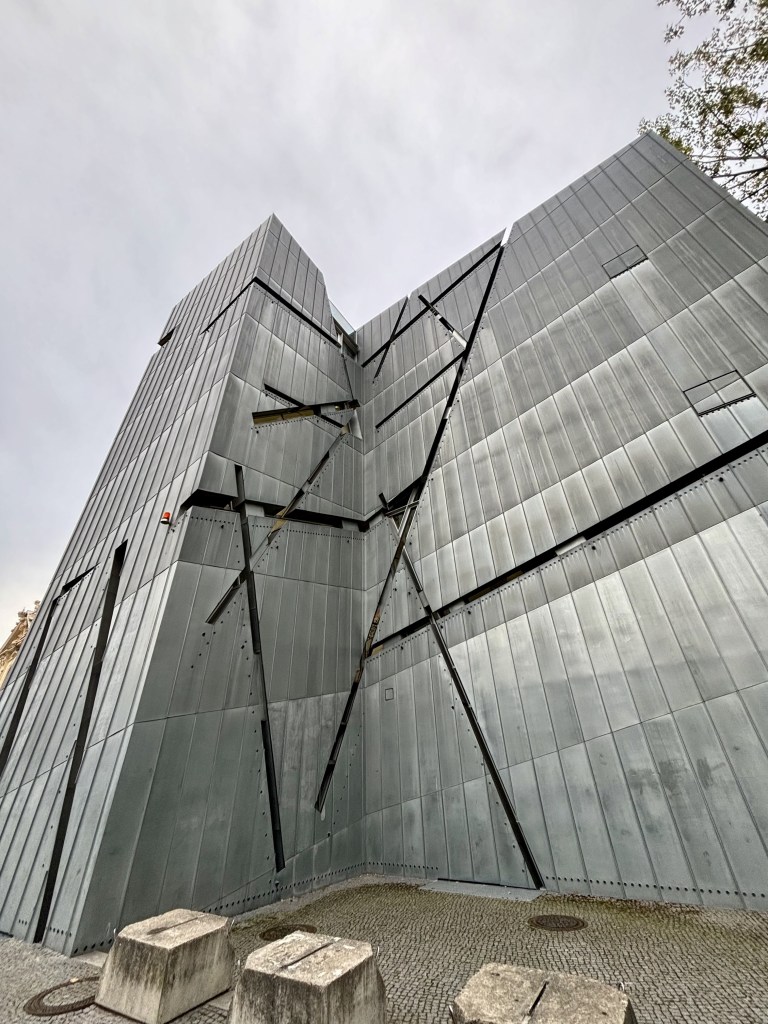
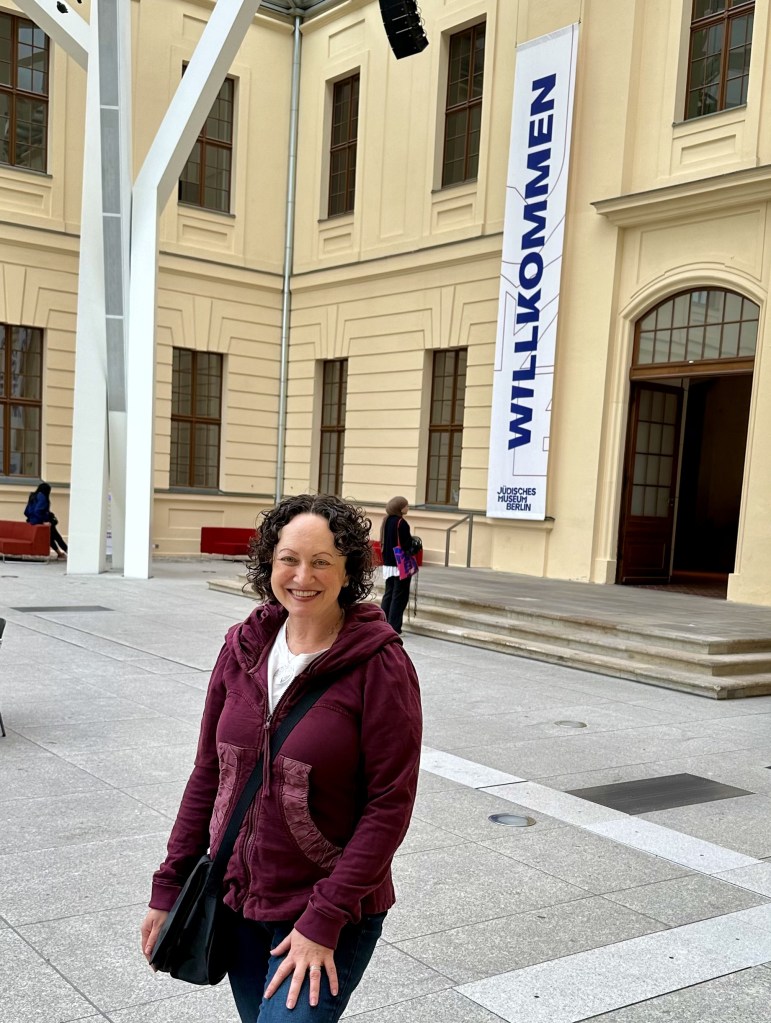

A surprise came in one of the exhibits about family businesses stolen by the Nazis, where we saw our family name Dannenberg listed as the owner of a fur shop in the same Kreuzberg neighborhood where the museum was situated. There was a descendant of the store owners named Meta Dannenberg who immigrated to the US, and we are curious to look her up to see what if any connection we may have with that part of the family. Also notable at the museum were statistics about the size of the local Jewish community. In 1979, there were only 6000 Jews left in Berlin, while there were over 1 million in NYC. But in 1990, Jews from the former USSR began moving to Berlin, with 100,000 arriving by 2007. By 2018, there were still only 200,000 Jews living in the entire country of Germany. This also sheds further light on why Germany is offering passports to any Jews whose grandparents left between 1935-1945 as a form of reparations.
And today for Rosh Hashanah, we attended services at a historic synagogue downtown dating back to 1866. The building had been burned on Kristallnacht in 1938, and further destroyed by bombings in 1943, but was rededicated in 1988 just before the wall came down. The rabbi there has revived the community and created an egalitarian conservative shul that was a perfect place to land to mark the holiday. I was a little sad when we first arrived and found the room was largely empty, with only 15-20 people in attendance and lots of open seats. It struck me then just how few Jews are left in Germany today. It felt even more significant to be there and be able to carry on Jewish traditions in this place that so many have worked hard to rebuild after a generation of loss and tragedy. Fortunately, the room filled up as we got closer to the Torah reading, and I felt more hopeful about the community rebuilding with the dozen or so young children in attendance.
All the prayers were led by women which was awesome, and the crowd seemed very international. We didn’t last until the end of the service to socialize, as we slipped out the back of the room for lunch after 3.5 hours of way more traditional liturgy than we are accustomed to, and just a few words in English. I was expecting the congregants to be primarily Russian, but given the large size of the Russian-speaking Jewish community in Berlin, they clearly have their own synagogues where services are held in Russian rather than German. We were happy to discover that there were prayer books in English, even if their last date of publication was 1988 and the translations were… a bit out of date, with the word patriarchy on more pages than I cared to count and none of the matriarchs mentioned. But it was a very moving experience to be there, and particularly poignant to chant familiar words and melodies like Aveinu Malkeinu with Jews from all over the world whose shared traditions brought us together.
All in all, it was quite a memorable week and a half, full of connections to my grandparents’ generation and so many links to traditions both local and communal.
 Sorgers in Berlin: A Midlife Adventure
4 responses to “Traditions, Roots and Historical Twists”
Gosh, this post moved me to tears. Thank you for sharing your daily experiences with such aplomb, humor and nuance. You are able to relay both the “macro” and “micro” so beautifully. I am sharing this with Matt and my German mother, both of whom will be fascinated to read this.
LikeLiked by 1 person
WOW, Nicole Beth. What a time! I appreciate your thorough coverage. I got to learn a ton, and you will be SO glad you have this account when you look back on this experience later. I raise a honey-dipped apple to your grandma Lisbeth (and my aunt Blanche), as they are the reason for our Beth connection!
LikeLiked by 1 person
As an engineer, I can’t begin to compete with my liberal arts trained daughter in her amazing expressiveness on our travels together during my two-week visit to Berlin! One anecdote I wish to add is that while Nicole was at the spa in Aachen, I happened by a bookstore where I espied a small section on Jewish history. One large book caught my eye – on the Jewish cemetery of Aachen. A quick perusal revealed that it had heretofore unknown (to me) information on my mother’s side of the family (Hirtz). The Hirtz family was one of the oldest families on record in Aachen (going back to the 1700s), and included their development of textile factories in years gone by. Nicole’s planning of all of our adventures was a true father-daughter bonding experience! What a joy!!!
LikeLike
Genealogy add-on: There was a Meta Dannenberg in our family – she was a sister of my paternal grandfather Albert Dannenberg. She emigrated to Buenes Aires. From the Block genealogy chart:
Albert Dannenberg, b. 1 Aug 1868, Adelebsen, Germany d. 21 Mar 1920, Duisburg, Germany (Age 51 years)
Meta Dannenberg, b. 8 Apr 1870, Adelebsen, Germany d. 31 May 1950, Buenos Aires, Argentina (Age 80 years)
Julius Dannenberg, b. 21 Aug 1877, Adelebsen, Germany d. 5 Aug 1933, Wuppertal-Elberfeld, Germany (Age 55 years)
LikeLike