
Now that we have crossed the threshold of the halfway point in our year abroad, we’ve had a notable shift in our mindsets, outlook and overall sense of ease here. The daylight hours are no longer so oddly short, the sense of permadusk has receded, the sun peeks out more often, and what had been regular drizzles have given us a delightful two-week respite, making biking much more pleasant and the dirt trails more solid and secure, even if punctuated by bits of frost crunching atop the remaining leaves on the forest floor.
We have plane tickets that place an end date to our mid-life adventure in sight, just 4.5 months away, which feels very soon! Rather than feeling restless and wondering what to do with so much free time (as was the case in mid-September), I’m now feeling that there is so much I have left to do in the few months remaining. Between reading, writing, practicing yoga, going to jazz concerts, exploring favorite new neighborhoods and restaurants, and seeing friends for walks and lunches, I now have a full array of fun activities to do here that keep me as “busy” as I want to be– which is a notable slowing down of my everyday life. I am feeling quite used to this pace and very happy about it. I certainly can’t imagine jumping right back into the frenetic schedule I kept before. As I experience the months and seasons of the year outside the confines of the school year schedule, I feel so free of the exhaustion and overwhelm that I associate with this time of year, and have so much energy to expend on what I want to be doing. What a luxury!
In short, we have mostly figured out how to operate here and have grown not only accustomed to it, but are actually really enjoying our “new normal” with jubilant late bike rides home from nights out, navigating the buses and trains (still sometimes ending up on the wrong platform but figuring out how to retrace our steps more quickly), and better navigating regular food shopping. Online shopping has definitely *not* caught on here, and people seem to walk or bike to the grocery store about every other day, which is both refreshing and time-consuming.
I must say that the grocery stores still yield some confusion: Why is there only ever one register open at a time? Am I supposed to dump all of my groceries back into the cart after they come through on the conveyer belt and bag them up at the narrow high-top counter near the exit, or can I just bag them while they are being rung up? Buying fresh bread is still a guessing game too with all of the spelt, rye and corn flour in the mix, some being too spongy, seedy or heavy while others are too bitter. We’ve also become accustomed to plucking feathers off the eggs that we leave out on the kitchen counter.
Apart from the ordinary, I’m also loving my role as our part-time travel agent, arranging our itineraries for upcoming trips. Julian has his ski week coming up with a school trip to Austria, while Jonathan and I take a bucket-list trip to Rovaniemi at the Arctic Circle to stay in a glass igloo for a few days, followed by the second half of the week in Milan (for a conference) and the Swiss Alps for Jonathan’s birthday. That part still feels like, “pinch me– is this for real?” And in April, we have planned a spring break trip to Portugal and southern Spain, with a week and a half exploring Portugal from Porto and Lisbon to the Algarve region, plus several days in my favorite cities of Andalucia. These incredible travel opportunities are a dream come true– and also mean weeks away from the home front here. That means we only have closer to 3.5 months left in our cozy yellow house on the edge of the forest, which I know will fly by before we know it.
In the meantime, I am also taking a new online memoir writing class on Wednesday evenings through a local bookstore that has been a springboard to expand my writing practice beyond what has largely been a travelogue. The class has pushed me to confront the complex myriad of feelings I have percolating about the nature of culture, nationality, my family’s past and the ways that the Jewish diaspora has been shaped by the politics of past and present.
So here is a brief snapshot into the writing I’ve been doing lately. This has become a rather accidental sabbatical project that I’m super excited about:

Tracks to nowhere. So many lives cut short. Thousands exterminated just from Berlin. Eleven million total. Six million Jews. But my relatives escaped this fate.
After hearing about it for some time, I finally visited a local Holocaust memorial to the Jews of Berlin who were deported from a nearby train station called Grunewald. At the station is the “GLEIS 17 Memorial” on which trains no longer run. Trees have been planted at both sides of the remaining track with bronze placards placed on the concrete platform above that mark each train that left from that station from 1941-1944. The plaques mark the date the train left the station, the number of Jews who were taken away, and the extermination camp destination (usually Auschwitz). It is chilling. I kept walking back and forth reading the placards, noting the dates and the number of people taken away on each train. There were distinct waves that corresponded to the war– months that went by where precisely 1000 Jews were taken on every train, others where the trains had upwards of 1800 people, and some dates where the trains had only 100 people aboard. Seeing the raw numbers, dates of departure and destinations shook me to my core.


Just outside the station, there were three additional memorials, one of which is in the form of a blue phone booth that contains a little free library, a small music box, and on top, a large image of a peace dove carrying an olive branch. I was there with a small tour group a couple of weeks ago. We were checking out the phone booth memorial when a seemingly shy and curious older gentleman approached us on the sidewalk as he quietly listened to our conversation about the memorial. As our guide looked towards him, he softly spoke up and said, “Hi everyone– I am the one who created this memorial.” His name is Konrad Kutt, and he has actually created similar phone booth memorials in several locations around Germany. It turns out that he lives in the neighborhood and comes to check on the installation regularly. Apparently the phone booth was set ablaze just two years ago in a hate crime, and has only recently been rebuilt. At our invitation, Konrad approached the phone booth, smiled for a few photos, and proceeded to open the door, telling us about the small collection of German history books inside, and the sound recordings operated by a small “audio box” with colorful numbered buttons that almost looked like a toy.
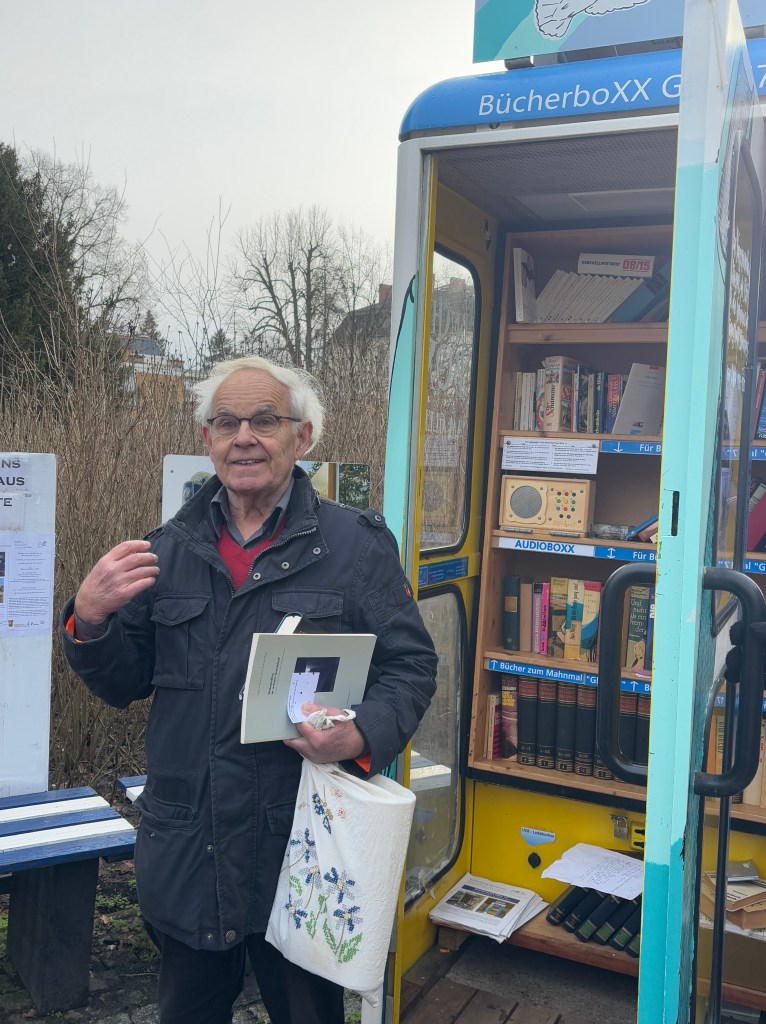
Konrad then looked my way, and asked if I spoke any Hebrew, as I had read the small Hebrew sign that said “give or take” on the side of the phone booth. I answered that I understood a little, and he proceeded to press the #8 button on the music box. A beautiful recording of one of my favorite Jewish melodies, “Eli, Eli” came on over the small speaker. I couldn’t believe it. These Hebrew lyrics are forever etched in my mind. I learned the English verses when I was young, but they held new meaning in this setting: “I pray that these things never end– the sand and the sea; the rush of the waters… the crash of the heavens… the prayer of the heart.” This song has always brought me comfort, and I often have an involuntary urge to sing it when I see waves crash at the ocean. At that moment, our guide broke the mood and rather abruptly bid Konrad farewell as he whisked the rest of the group off to continue the tour. I stayed back for a few minutes to talk to Konrad and hear more about his work.
But then I had to get out of there. I could feel the tears welling up in my eyes. I briskly walked back to the train station to head home. As soon as I got inside the station, I ran up the first staircase I saw to look for my train. But instead of finding the S-Bahn platform, I found myself back at the memorial– the tracks to nowhere. I was all alone on the platform, in the midst of a sea of memorial placards for the trains that took Berlin’s Jews away to the death camps. I immediately started to weep. It was the first time I have cried since we got to Germany. I just stood there and let it all out. My grandparents survived, boarding a local train just an hour south of Berlin in 1937, and headed west. They rode out of Germany and onto Holland for several months before taking a boat towards the Status of Liberty, landing at Ellis Island. Thousands of remaining Jews in Berlin were shoved onto trains at this station in Grunewald starting in 1941, and were sent east to their death in the camps. Most were not as fortunate as my family was.
My grandfather refused to set foot on German soil after they escaped, even decades later when he traveled to Europe with my father. He would only get out of the car in Switzerland or France; but not in Germany. And yet here I am, here in 2025, a newly minted German citizen. Being here, knowing which neighborhoods were predominantly populated with Jewish families, I can picture the vibrant, successful Jewish communities here that were effectively dissolved.
Perhaps Berlin was actually the logical next chapter for me to explore in my own life’s trajectory, even if I didn’t realize it when we made the choice to come here. In 1933, Berlin’s Jewish community of 160,000 was thriving as the largest in Germany, with ⅓ of the Weimar Republic’s Jewish population. 60% of those Jews fled Germany over the next six years– those who were wealthy enough to afford to relocate– and became refugees in exile. They fled to the US and what was then the British Mandate of Palestine. But that’s another story.
It turns out that I had relatives who were still in Berlin in 1938. I never knew of them before seeing our family name in an exhibit at Berlin’s Jewish Museum just a few months ago. They owned a fur shop in nearby Charlottenburg that was destroyed on Kristallnacht. The owners’ daughter, Meta Dannenberg, somehow escaped to Buenos Aires, where she lived to be 80 years old. I wish I could have known her, and now wonder if I have any long-lost relatives in Argentina.
My dad’s family were among those fortunate enough to have a way out. Only 6500 Jews remained in Berlin when WWII ended. Literally 96% of this community was either forced into exile as refugees in foreign lands, or killed by the Nazis. Today, that community has been replaced by much smaller and highly divided groups of Russian and Ukrainian refugees and a sprinkling of expats.
What is a homeland? Is it a place to which one is connected through ancestry? Is it a place with which you share an identity? And how do you measure nationality? Is it the passport you hold, the place you live, or a place you are from? How do modern politics factor into one’s sense of nationality? Where do culture and language fit into the picture? Cultures and languages can be learned, but under what conditions?
Exile is one. My grandparents had no choice but to learn a new culture and language. They did so under duress, gradually over decades, and it was their children and grandchildren who truly became American– not naturalized, but nationals by birthright. They were faced with a new culture that was foreign, that required study and acute observation to learn and assimilate. Hans Dannenberg and Lisbeth Hirtz Dannenberg were surrounded by a community of German Jewish friends in Berkeley. They kept their language, cuisine and friendships from home. Home was Germany, and California was a foreign place where they sought refuge. It was their place of exile and freedom all at once.
My temporary home is now Germany, where I am a dual national. But it is abundantly obvious that I am an outsider here– a visitor. This is not my authentic nationality– it is one that was taken from my grandparents. I’m not living in exile. My life is not acutely threatened by the politics of my nation of origin. I may have been fleeing burnout and the larger climate of national political chaos, but that is not remotely comparable to escaping genocide. I have learned how to live here, and feel a deeper sense of connection to my grandparents’ lives by virtue of experiencing this place. But we are lucky– we are not refugees; we are not living in exile. We have options. Would I learn German if I were in exile as a refugee? Of course, I would have no choice but to do so.
But I am here on a free-spirited journey– escaping from the rote rhythms of the fast-paced, frazzled culture to which I became accustomed. Now that we have been here for a while, it is all too clear to me that home is California. Sure, I technically have two nationalities– or at least two passports. But the US is where I feel an intangible sense of comfort and familiarity– nestled in my community of friends and family, where I know how to be, and the smiles and light-heartedness around me feel so very normal. Germany does not feel like my home. I can admire the nation’s commitment to historical memory and reconciling their past wrongs, but I don’t need to give up my birthright nationality nor give up my own culture to do so. Politics in the US right now are absolutely terrifying, and I know that talking about leaving the country has become more commonplace. But from where I sit, anti-immigrant sentiment and anti-semitism are growing in Germany too. So why am I here?
For sabbatical, I wanted an escape from the mundane– the everyday stresses of teaching and managing parent expectations about the college industrial complex were waring me down. The burnout was real, and I felt a yearning for fresh experiences, new scenery, and a return to the spirit of adventure that had driven me in my 20s. I wanted to feel like I did when studying abroad in college– when everything was so exciting and ripe for exploration, my thirst for deeper understanding absolutely unquenchable. My heart was full of wanderlust– not the kind that would have put me in war zones or situations that merited “danger pay” (like some of my colleagues) but more of a yearning to experience new places, to meet people with their own distinct cultural norms to expand my views on the myriad ways of living on this planet. Whether meeting hunter-gatherers on our honeymoon in Tanzania or traveling for my USAID jobs– visiting after-school programs outside of Ramallah in the West Bank or riding on motorcycles to the former slave ports on the Gold Coast in Benin– my 20s were a time when I felt that I was truly a citizen of the world.
I was deeply craving the chance to reconnect with my younger, more idealistic self, to regain a sense that I was not just another cog in the wheel, a checkpoint for students to pass through on their way to pursuing jobs in finance to climb the corporate ladder, but a human being seeking connection, open to the myriad of wonders outside of my teeny tiny bubble. This was not just about traveling– taking in new scenery, vast troves of knowledge curated in phenomenal museums, and meeting new people, although each of these has been a breath of fresh air. I also wanted to burst out of my narrow box in search of new ways of thinking and living. A slower pace. On sabbatical, my main goal was to have the time and space to revisit my own sense of purpose– to spend my days reflecting on this mid-life juncture and how I want to design my forthcoming chapters, beyond the whirlwind of day-to-day parenting and teaching that have consumed me for the past 20 years.
I thought that Germany could be a place of refuge for us if we needed it. Just as my grandparents fled political persecution and tangible threats to their lives, we could flee the idiocy of a President who ignores the Constitution, international laws and basic norms of human decency. The US is now ruled by a grown-up toddler who speaks in superlatives and contradictions, threatening the security of us all– and has given up an insane amount of power to an unelected maniacal overlord. While I’m skimming through the new daily substack subscriptions & headlines that appear in my email, I am trying to keep the time I spend spinning about the insanity of it all in check, with the realization that our stay here is flying by.
So here I am. Riding over bumpy tree roots in the woods. These roots make me stumble, jostling my brain and shaking my fuzzy visions of my own family’s roots embedded in this country, while feeding the trees in the deep forests around our house that are littered with shrapnel from gunshots fired to keep people from reaching freedom and democracy in the west. My attention is now drawn to the irregular patterns of fluffy celadon moss growing in the otherwise dormant woods. That new growth holds the promise of spring, and with it, bright new energy and vibrancy that percolates through the air as I carve my path through the forest.
 Sorgers in Berlin: A Midlife Adventure
4 responses to “A turning point”
WOW!!! BEAUTIFUL! I’D SAY YOUR WRITING CAREER IS LAUNCHED! Congratulations! Love, ANN
LikeLike
This eloquent, poignant piece deserves wider publication. It provides an exceptional lens into the current moment in time…one that future generations will value. A beginning chapter…
LikeLiked by 1 person
Nicole, this is so beautifully written. I teared up about your encounter with the man who created the phone booth memorial, and had to look up the song – enchanting, to say the least.
LikeLiked by 1 person
Guess what? I e-mailed the memorial’s creator to thank him for his work, and he invited me to his home for tea next week!
LikeLike